Establishing a Starting Point
fusionSpan opened the engagement by demonstrating how our own teams use Claude day to day, then built example prompts ASQ could adapt into their own skills and plugins. This shifted the conversation from what Claude might theoretically do to what ASQ's staff could build for themselves. Scoping began at a June 18 kickoff, and the full engagement was delivered by July 1.
Reduction in time to fulfill a standard data request
Self-served, down from 30 to 90 minutes via IT
Connecting Claude to ASQ's Data
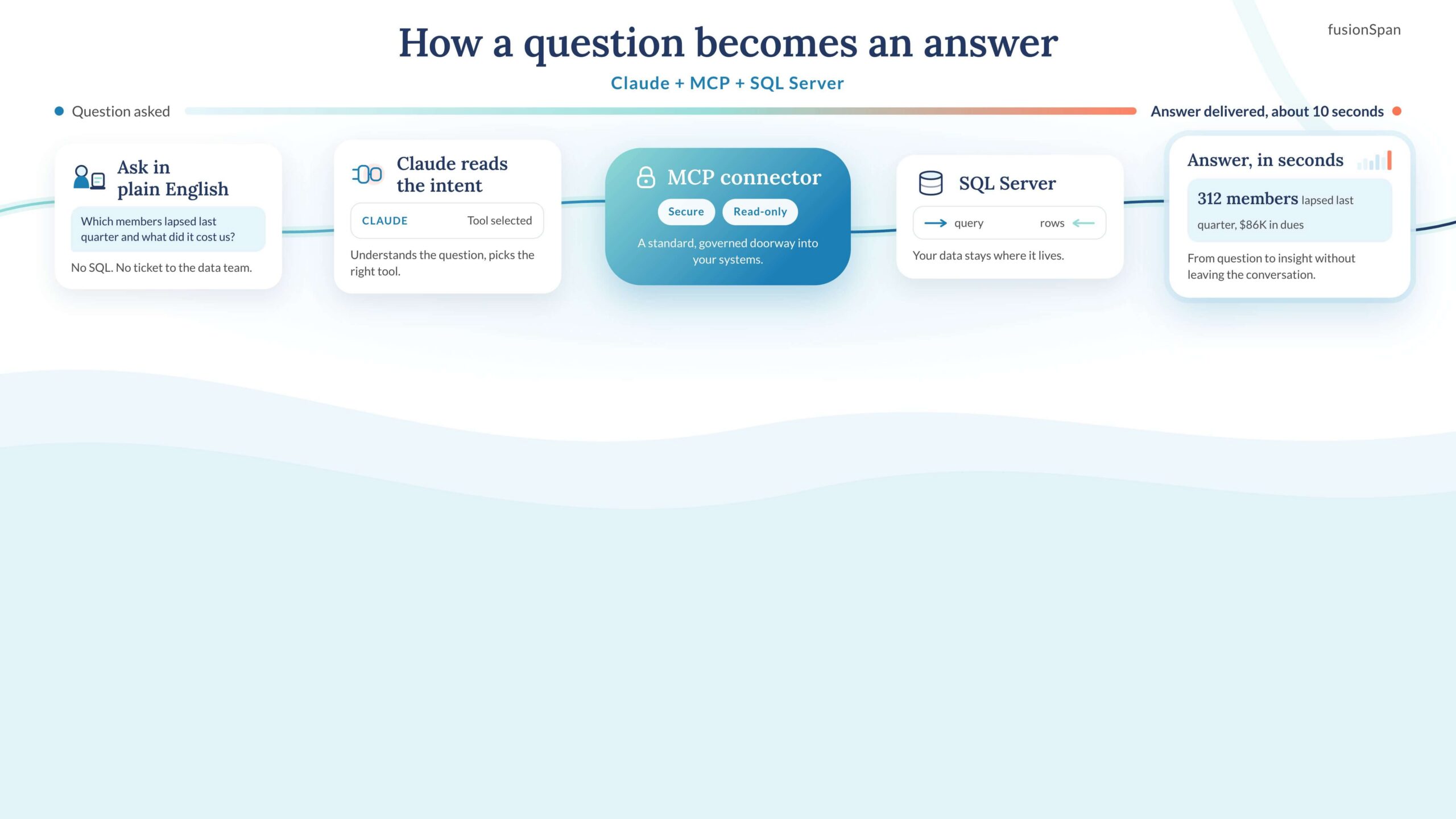
fusionSpan designed and helped with prompt building to create MCP servers connecting Claude directly to ASQ's databases. We also showed ASQ's team how to build and deploy their own MCP servers. Rather than exporting data or standing up a separate reporting layer, this let Claude query ASQ's operational data under scoped, controlled access. Because access is enforced at the connector rather than left to user discretion, what Claude can reach became a configuration decision rather than a matter of trust.
Building Confidence in Security
In parallel, fusionSpan walked ASQ through how we structure security in our own Claude environment: how permissions and data access work, how administrative controls are configured, and what we recommend for an organization at ASQ's stage. ASQ's team took those recommendations and applied them to their own setup. The value was not a document handed over at the end, but leadership understanding the controls well enough to make access decisions themselves. This is the work that turned a promising evaluation into something the organization was willing to expand. Initial testing was carried out with ASQ's IT team, which established the sponsorship the broader rollout would depend on.
Scaling Under ASQ's Own Ownership
ASQ took ownership of rollout planning immediately following delivery. Through July and August, access extended beyond the IT team to additional groups, driven by ASQ's own internal planning rather than a fusionSpan-managed workstream. Expansion has continued since.
The engagement ran two weeks from kickoff to delivery. ASQ moved from a single test license that had gone unused to active adoption by the IT team within that window, and to additional teams over the following two months, with all expansion after the first two weeks driven internally.
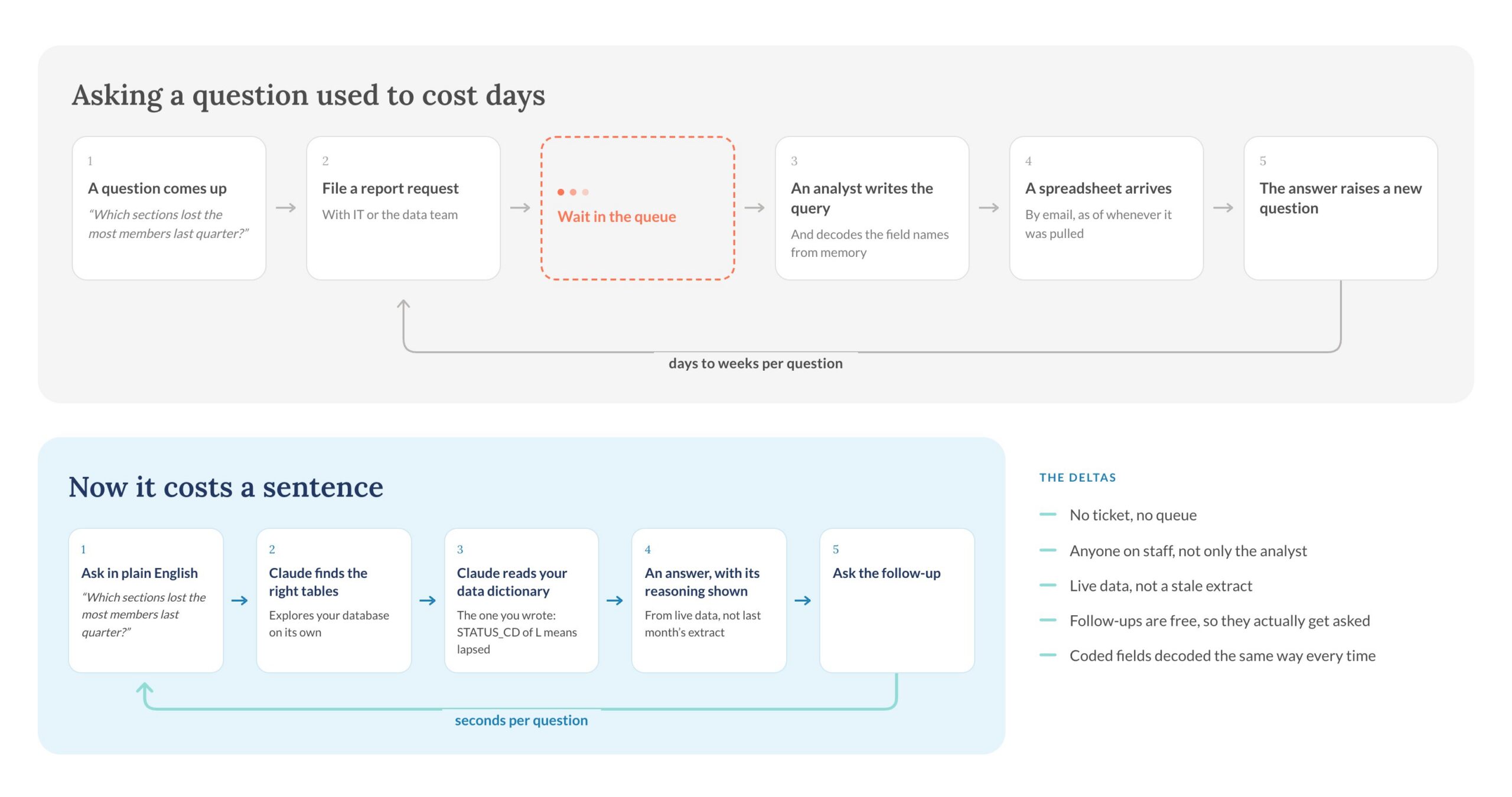
ASQ estimates that a standard data request previously took an IT team member 30 to 90 minutes to fulfil. Staff now retrieve the same information themselves in roughly five minutes through Claude, a reduction of 83 to 94 percent, with the IT handoff removed entirely.
The difference is how quickly we can get from a question to an answer. Data that used to require pulling a report is something our team can now just ask about directly and get back something useful.


Ongoing Enablement
fusionSpan continues to serve as ASQ's single channel for Claude enablement. Questions from their IT team route through fusionSpan rather than being absorbed unevenly across internal staff, which keeps answers consistent as the user base grows. The two teams meet on a recurring basis to work through active blockers, covering new skill development as teams identify repeatable workflows, permissions configuration as new groups and data sources come online, connector activation for systems beyond SQL Server, usage and credit guidance, and rollout planning.
Two weeks after kickoff, ASQ was expanding on their own. That was the point.