The fusionSpan Blog

What Is Salesforce’s “Agentic Enterprise”?

Author Image
By Jason Cookman |April 28, 2026
EventsSalesforce
What-Is-Salesforces-22Agentic-Enterprise22

And What Do Associations and Nonprofits Need to Know?

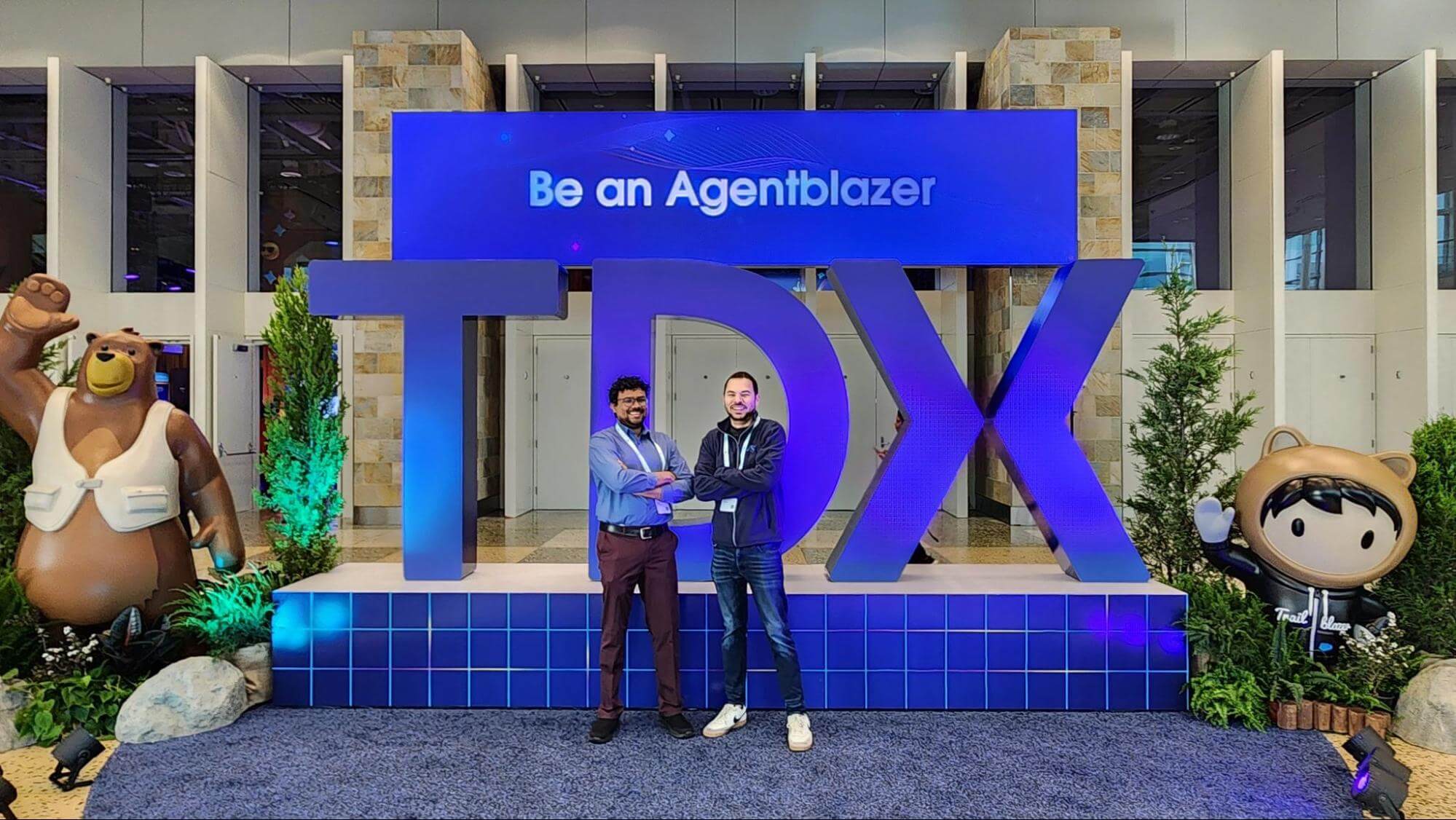
At Salesforce’s TDX last week, one central theme was inescapable. The “agentic enterprise” is on the rise, and, at least in Salesforce’s eyes, embracing the shift is every organization’s ticket to the future.

We’re excited because this type of paradigm-shifting innovation is our jam. But we also see the gap between where many associations and nonprofits are now (still discovering ways to improve personal and team-level productivity), and where the “agentic enterprise” is asking them to be.

This perception gap can put a pause on adoption, but stalling here is counterproductive. This type of agent-enabled work environment will be a lifesaver for nonprofits and associations that have been chronically understaffed and underresourced. The best time to start learning was yesterday – the second-best time is now.

So let’s dig in!
This is a Paradigm Shift

The term agentic enterprise describes a model where humans and AI agents work together across every workflow.

Most software today is passive. It stores information, surfaces it on request, and executes what it’s told. Agents, on the other hand, can take a goal, pull context from multiple systems, make decisions, and act, with or without human initiation.

For my development team, we’re looking at how this change might let us shift away from the Agile method and toward a less cyclical agentic framework, where AI participates in writing, testing, and deploying code alongside engineers.

For your membership team, it might look like an agent that handles a renewal inquiry end-to-end: pulling the member’s history, drafting a response, and escalating to staff only when judgment is required.

This is a meaningful shift that will fundamentally change how we do work.

Headless 360 Changes How You Work in AND With SalesforceHeadless 360 Changes How You Work in AND With Salesforce

This shift in thinking is supported by Headless 360 – Salesforce’s new, fully composable, API-first framework, where everything is now an API (Application Programming Interface), MCP (Model Context Protocol), or CLI (Command Line Interface).

This is a huge change, and probably deserves a blog of its own. But at its core, it’s designed to let your team interact with Salesforce across surfaces without ever needing to log in. It’s organized into four layers, each exposed via REST and MCP endpoints:

  • System of Context: Where your data lives (Data 360)
  • System of Work: Where business logic and workflows happen (Sales, Service, Marketing)
  • System of Agency: Where you build, deploy, and manage agents (AgentForce)
  • System of Engagement: Where your team and agents work (Slack, mobile, web, third-party tools)

The practical implication: agents are not locked inside a single application. They can be composed across tools, surfaces, and vendors. 

Agentforce Works Across Every Surface

With Headless 360, an agent’s logic lives in one place (the system of agency) and can be engaged on any surface in the engagement layer. This means that an agent you build once can be deployed anywhere your team already works: Slack, Microsoft Teams, Claude, ChatGPT, mobile, or your own web experience. No duplicate work needed.

An Important Distinction: Deterministic vs. Probabilistic

Most software is deterministic. The same input produces the same output, every time. That predictability is what makes software trustworthy in operational contexts.

AI agents are probabilistic. They reason through a problem and produce outputs that can vary. That flexibility is what makes them useful for tasks involving judgment, ambiguity, or unstructured data.

Both have a role. A billing process should be deterministic. A member inquiry that requires pulling context from multiple sources and forming a response is a candidate for an agent. The mistake is treating these as interchangeable. But in a little nuanced twist, you CAN use your probabilistic to build deterministic.

How is Salesforce Supporting the Shift?

A paradigm shift can’t be expected to take root unsupported. Salesforce is funneling significant resources to support teams and developers in adopting the “agentic enterprise mindset.”

If you’re excited by this stuff like I am, here are a few of the resources we’re especially interested in digging into:

Agent Script is now GA, and it’s supporting faster agent building.

The backbone of Agentforce, Agent Script is a single flat, versionable file that deterministically controls how an agent runs. It handles:

  • Sub-agent (formerly topics) routing
  • Variable storage
  • Reasoning instructions
  • Guardrails (e.g., “if a discrepancy is found, always escalate to a case”)
  • Human handoff logic

This has major implications for speed and ease of agent development. In the TDX keynote, we saw an agent built, tested, and deployed entirely from the terminal using Claude Code with fewer than 10 commands – 10 minutes from idea to working prototype.

Agentforce Labs gives builders “first looks.”

Agentforce Labs is a new space inside Agentforce where Salesforce ships pre-GA innovations for builders to try first. It includes a “getting started” experience to walk you through spinning up an org, provisioning, Agent Script configuration, and agent deployment. It supports Claude, Codex, and other tools directly from the UI.

Agentforce Vibes 2.0 (formerly Code Builder) scales agentic development.

Salesforce’s agentic integrated development environment (IDE) is built to provide developers with additional resources that speed and scale agentic solution development, and ships with:

  • 30+ skill files with detailed instructions for the agent (how to write AgentScript, what to do, what to always do, how to validate itself).
  • 60+ MCP commands, all headless, accessible from Claude Code, Cursor, Codex, Windsurf, or any tool of your choice.
  • Open agent harness that supports both the Anthropic Agent SDK and the OpenAI Agents SDK.
  • Salesforce Metadata Catalog MCP, allowing agents to build with the full context of your org’s metadata.
  • Rich visual schema for custom/standard objects.
  • Real-time inline preview.
  • Multi-UI framework support.

AgentExchange and Developer Incentives will Speed Delivery of Customer-Facing Resources

Salesforce announced AgentExchange, a marketplace for composable skills and MCP tools (not just full agents), and a $50 million fund for developers who want to build and monetize agents/skills on the platform. These two incentives will create a whole new library of tools and resources for customers to use on a much shorter timeline.

What the Agentic Enterprise Means for AssociationsWhat the Agentic Enterprise Means for Associations


Associations are relationship-driven, process-heavy, and staff-constrained. And a significant share of your work involves digesting context pulled from multiple systems, and turning it into a response, a recommendation, or a next step. These characteristics all make associations strong candidates for agent-supported work.

Earlier eras of AI were limited by this context scope. But the agentic enterprise is built with this complexity in mind.

A few concrete examples worth evaluating:

  • Member services: An agent with access to membership records, event history, and communication logs can handle a wider range of inquiries without escalation.
  • Credentialing and compliance: Monitoring application status, flagging missing documentation, routing exceptions… These are rule-bound workflows that agents can manage with appropriate guardrails.
  • Event operations: Agenda changes, registration exceptions, speaker communications – high-volume, repeatable, time-sensitive.

Agents at Work: What to Watch and When to Question

Agents are genuinely useful in the right contexts. They are also probabilistic by nature, which means they will occasionally produce wrong or unexpected outputs. In an association context, where member trust and data integrity are non-negotiable, that has to be taken seriously.

Before deploying agents in member-facing or data-sensitive workflows, associations should be asking:

  • What are the guardrails, and who defines them?
  • Where does the agent hand off to a human, and under what conditions?
  • How is agent behavior versioned, audited, and rolled back if needed?
  • What data is the agent accessing, and what are the privacy implications?

These questions must have clear answers before you move any solutions to production. Technology is moving faster than governance can adapt, and this gap introduces vulnerability that should be closely monitored.

The Bottom Line

The agentic enterprise is not some distant, future state. It’s being built now, and the foundational infrastructure (agent orchestration, MCP connectivity, cross-platform deployment) is further along than many association technology teams realize.

Want some help getting a handle on this? The team’s happy to sit down with you and unpack what this means for your org specifically. Just book a time.

Jason Cookman
What Is Salesforce’s “Agentic Enterprise”?

Jason is a Senior Salesforce Architect and has been with fusionSpan since June 2014. He has multiple Salesforce Certifications and has led the solution architecture on dozens of Salesforce implementations. In addition, he has created apps on a variety of platforms and frameworks including MuleSoft, Spring Boot, AngularJs, and Drupal. He has been coding in Java, PHP, and JavaScript for more than eight years and has over six years of experience developing on the Salesforce Platform in Apex, Visualforce, and Lightning. He is a graduate of the University of Maryland with a double bachelor’s degree in Computer Science and Accounting. Jason’s favorite foods are ramen, ramen, and more ramen.

More posts